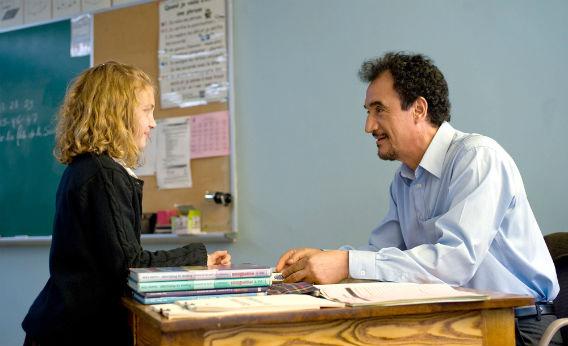
Nélisse, Fella in "Monsieur Lazhar"
Film Friday (Spoiler alert)
Last week Julia and I went to Shirlington, Virginia (one of the few venues in the area where one can see foreign films) to watch Monsieur Lazhar, the French Canadian film nominated for best foreign film. We came away impressed with its insights into education and the educational system. At a time when so much of the discourse about public education is ideologically driven, it was a relief to see a film which acknowledges the real issues.
Monsieur Lazhar is about a school that has just witnessed the suicide of one of its upper elementary teachers. More disturbingly, she may have hung herself to get back at a boy who complained about her when she touched him. The students are in shock, the boy is acting out, and the overburdened principal can’t get anyone to handle the class. At this point Monsieur Lazhar walks in.
An Algerian political refugee whose wife and family have been killed by thugs, he has read about the incident and sees a job opportunity. Or maybe he sees an opportunity to connect with kids after having lost his daughters. In any event, he lies about his credentials and the principal hires him without doing a sufficient background check. That failure will cost her her job but we are sympathetic. Sometimes it is all overworked bureaucrats can do to keep the school going, especially given all the regulations that must be attended to.
Some of these regulations involve teachers touching students. The rules seem overly restrictive, and the gym teacher complains that he can’t have the students do gymnastics because it would require him holding them. We are sympathetic with his point of view, but it then emerges that the teacher who committed suicide probably did engage in improper touching. The film refuses to retreat into easy black and white answers.
Lazhar relies on his own educational experience to teach the students, which means that he gives them dictation assignments from Balzac rather than from someone more contemporary. He also straightens the rows, which had been in a circle. His formality puts the children off.
But they come to like him, do well on their tests, and find the stability they need. His assignments also open up genuine dialogue, which the school has discouraged. In a pivotal scene, young Simon blurts out what actually happened. Because Lazhar is focused on the health of students over school regulations, he takes some chances, blows his cover, costs the principal her job, and is sent away. In a final moving scene, however, he writes a fable, just as he has asked his students to, and reads it to them. They get its application to their situation. Profound learning has taken place.
We need films like this because our country’s educational battles, like so many of our other political battles, take place in an atmosphere where, it seems, many of the combatants agree to be stupid. We’re more interested in our own concepts than in our children. I wrote recently about how teachers and librarians sometimes provide controversial books to their students because they see what they need rather than what is ideologically correct. That’s the drama of Monsieur Lazhar.
There are powerful forces at work in our politics to make us all two-dimensional. Movies like Monsieur Lazar fight for wisdom.