“Sandy” conjures up for me a traumatic childhood reading experience along with a passage from “The Tempest.”
The onslaught of Hurricane Sandy reminds us of King Lear’s storm experience.
Mitt Romney would find a kindred soul in Joseph Heller’s cynical entrepreneur Milo Minderbinder.
Denise Levertov wrestled with God’s relationship to evil in the world.
The San Francisco Giants would make their 1960′s forebears proud.
Scott Bates proves an environmentalist’s revenge fantasy against those violating the earth.
Steinbeck and the Beowulf poet both point out that piling up wealth does not lead to happiness.
Holden Caulfield would definitely apply his favorite word to Mitt Romney.
Serving my students a Jane Austen high tea made the novels come alive.
As the U.S. steps up drone attacks, Edith Sitwell reminds us of the psychological cost to ourselves.
Describing the slaughter of the buffalo herds by whites, Mary Oliver draws on Sioux religion to imagine them as not altogether gone.
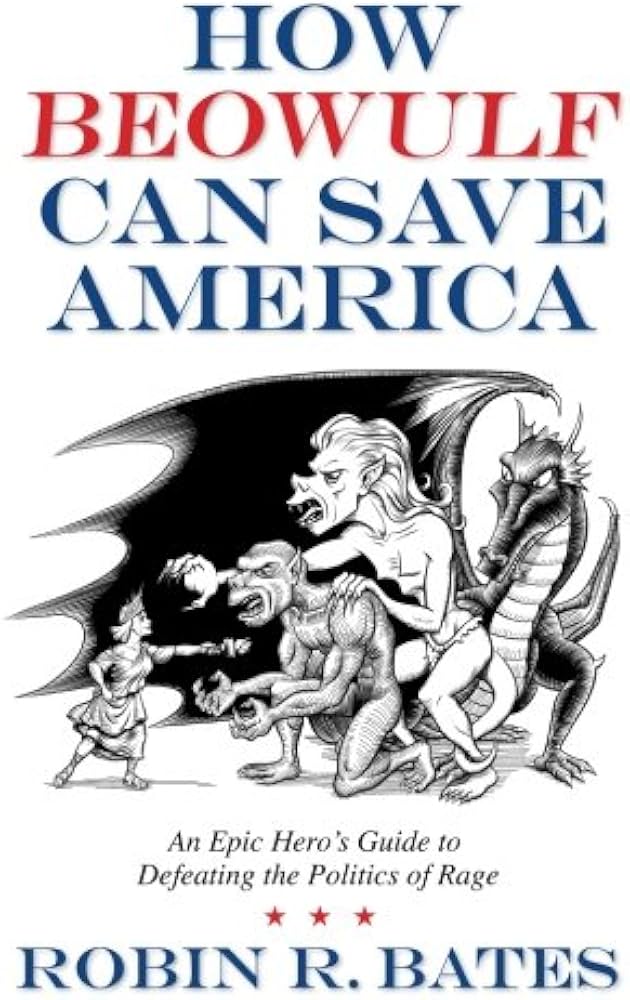
If you have a Kindle, beginning tomorrow (Sunday) you can upload for free How Beowulf Can Save America:An Epic Hero’s Guide to Defeating the Politics of Rage. Kindle allows authors to offer their ebooks free of charge for five days so the offer will last through Thursday (Oct. 25). Please take advantage yourself and let other people [...]
Seeing “the Captain” Derek Jeter break his ankle conjures up Whitman’s “captain” poem.
In this Scott Bates poem, a dream of flying frees us from life’s frustrations.
Obama, taking a cue from Kipling and maybe Edward Rowland Sill, bounced back in Tuesday’s debate.
“Catch 22″ captures a number of the contradictions in the 2012 election.
Hardy’s “Darkling Thrush” conjures up hope in dark times.
Atwood’s “Handmaid’s Tale” addresses issues raised by the Taliban shooting of a Pakistani school girl and also speaks to our abortion fights.
The Book of Job, Herbert’s “Denial” and an internet poem about Job’s Wife capture the language of suffering.
One our ideal, Lance Armstrong has proved to be more like Kurtz in “Heart of Darkness.”
In last night’s, Joe Biden found himself up against a modern-day version of Dickens’ Bounderby from “Hard Times.”
Like Henry Crawford in “Mansfield Park,” Mitt Romney is inconstant and will say anything.
Literature as therapy, Greek tragedy as soap opera: assorted articles about lit and life.
Posted in Bishop (Elizabeth), Levertov (Denise), Moore (Marianne), Sophocles | Tagged "Variation on a Theme by Rilke", catharsis, Denise Levertov, Elizabeth Bishop, Greek tragedy, Marianne Moore, Oedipus Rex, Sophocles |
Is Obama in a funk over his responsibilities as a war president? If so, “Beowulf” has answers.
Mitt Romney’s “tangled web” entraps Obama and recalls Sir Walter Scott.
Posted in Congreve (William), Scott (Sir Walter), Shakespeare (William) | Tagged 2012 election, Barack Obama, Marmion, Merchant of Venice, Mitt Romney, politics, Sir Walter Scott, William Congreve, William Shakespeare |
As George Herbert and Fiona Sampson make clear, partaking in the eucharist feat is our way of becoming intimate with God.
The film “Moneyball” helps explain this year’s extraordinary story of the Oakland Athletics.
Poetry by E. A. Robinson and Edna St. Vincent Millay played a key role in my cousin’s memorial service.
Posted in Bates (Daniel), Robinson (Edward Arlington), St. Vincent Millay (Edna) | Tagged "I burn my candle at both ends", "L'Envoi", "Luke Havergal", "Minniver Cheevy", Ballad of the Beanetown Bosox, Daniel Bates, death and dying, E. A. Robinson, Edna St. Vincent Millay |
Achebe’s “Things Fall Apart” contrasts rigid and tolerant Christianity in ways that will benefit our own society.
“Cider House Rules” calls out those anti-abortion proponents who refuse to face up to the lengths to which some desperate women are willing to go.
Playing the card game in “Mansfield Park” gives students insight into the meaning of games.